Posts

James Hogg 1770 -1835
Image
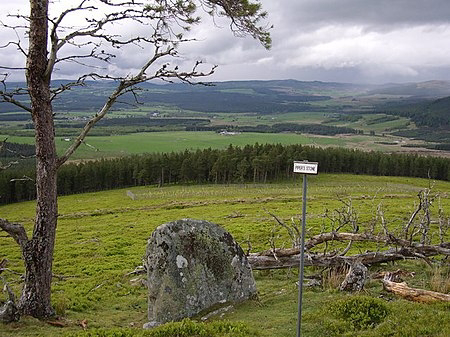
The  Piper's Stone , a boulder upon which a mortally wounded Jacobite piper was said to have played the bagpipes during the Battle of Cromdale The Haughs Of Cromdale. This ballad, the original author unknown, was collected and edited by James Hogg and concerns the Battle of  Cromdale  in Scotland, fought on April 30 and May 1, 1690 between supporters of James VII, called Jacobites, and the supporters of William III. The Jacobites would be defeated in two engagements near Cromdale village, Strathspey. The ballad describes details of the battle and the participants, but although a defeat by the Jacobites the unknown author turns it into a victory by adding details of the  Battle of Auldearn , which was fought by Royalists led by the Marquis of Montrose years before on May 9, 1645, and wrongly mixes up the opponents who were Scottish Covenanters with Oliver Cromwell's Roundheads. It is possible that elements of the little known  Battle of Tul...
Hielan Sodger (Trad.) - Highland Soldier

Image
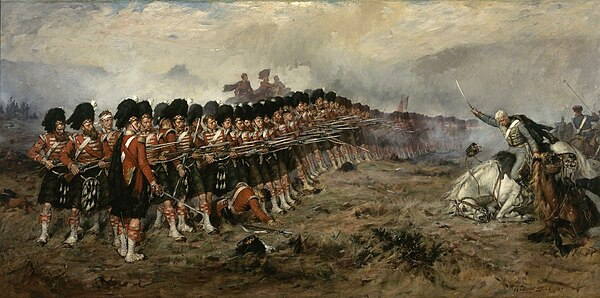
The Thin Red Line  was an military action of the  Battle of Balaclava  on 25 October 1854, during the  Crimean War  where Highlander infantry stood their ground against charging Russian horse-troops, and caused them to retreat. Robert Gibb, The Thin Red Line , 1881,  National War Museum , Edinburgh Henri Félix Emmanuel Philippoteaux General Michel Ney’s French cavalry  attacks the Highland regiments at Waterloo, June 18, 1815, only to be driven back by well-timed volleys. Scots in Highland uniform enduring the rain before the artillery shells fall at The Battle of the Somme, July 1 - November 1916 The 51st Highland Division at the Battle of El Alamein, October 1942 Hielan Sodger (trad.) The author of the song is unknown. The song concerns the love of a girl for a Highlander called up to a military regiment to travel overseas. She determines to sacrifice everything and follow him. The author of the song is unkn...

The Battle of Otterburn

Image
The Death of Douglas at the Battle of Otterburn on 5th August 1388: picture by Sir John Maxwell The Battle of Otterburn took place on August 5, 1388. It was part of a three-pronged assault by Scottish forces against the English. A Scots army sailed across the Irish Sea to attack Carrickfergus, the Duke of Albany raided the western marches towards Carlisle, and James Douglas, 2nd Earl of Douglas, attacked Henry Percy in Northumberland. Douglas defeated Percy, but was killed in the battle. The ballad -  The Battle of Otterburn  appears in a manuscript dated circa 1550. The author is unknown.  It was printed on broadsides as both  The Battle of Otterburn  and  The Battle of Otterbourne .  It was later printed in Percy's  Reliques , collections by David Herd (1776) and Walter Scott's  Minstrelsy of the Scottish Border  (1833). The  Child  B allads  are  305  traditional  ballads  from England an...

Rev. John Skinner 1721-1807

Image
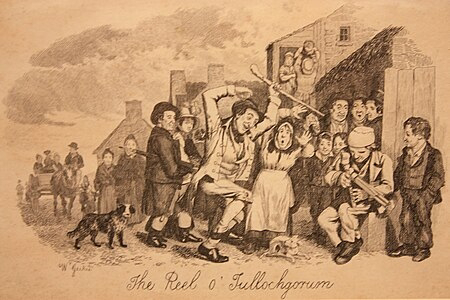
The Reel of Tullochgorum Artist Walter Geikie  (1795 - 1837)  Tullochgorum by Rev. John Skinner Come , gi'e's a sang, Montgomery cried, And lay your disputes all aside, What signifies't for folks to chide For what's been done before them? Let Whig and Tory all agree, Whig and Tory, Whig and Tory, Let Whig and Tory all agree, To drop their Whig-mig-morum; Let Whig and Tory all agree, To spend the night in mirth and glee, And cheerfu' sing alang wi' me The reel of Tullochgorum. O, Tullochgorum's my delight, It gars us a' in ane unite, And ony sumph that keeps up spite, In conscience I abhor him. Blythe and merry we's be a', Blythe and merry, blythe and merry, Blythe and merry we's be a'. And mak' a cheerfu' quorum. Blythe and merry we's be a', As lang as we ha'e breath to draw, And dance, till we be like to fa', The reel of Tullochgorum. There needs na' be sae great a phraise, Wi' dringing dull It...

Zero the Silent

Image
DC Thomson  is a publishing company based in  Dundee , Scotland. Founded by  David Couper Thomson  in 1905, it is best known for publishing  The Dundee Courier ,  The Evening Telegraph  and  The Sunday Post  newspapers, and the comics  Oor Wullie ,  The Broons ,  The Beano ,  The Dandy  and  Commando . It also owns the  Aberdeen Journals Group  which publishes the  Press and Journal . DC Thomson also published  Adventure   a boys' story paper from 17 September 1921 to 1961, then it was merged with  The Rover .  O n February 14th 1931,  Adventure  #485 introduced a serial of stories featuring a masked crime-fighter called Zero the Silent. The serial ran for several weeks. Unfortunately we don't know who the author was.  Zero the Silent, the human fly, was a masked pulp mystery man. He was a disgraced Scotland Yard detective who invented...

The Battle of Harlaw

Image
Battle of Harlaw monument near the Chapel of Garioch. The Battle of Harlaw The poem describes a medieval conflict between armies of lowlanders and highlanders on July 24, 1411 near Inverurie, Aberdeenshire. The author is unknown although there is a reference to a work called The Battle of Harlaw within The Complaint of Scotland, c.1549, unfortunately the lyrics are lost. Sir  Walter Scott  mentions a ballad called Harlaw in his 1816 novel  The Antiquary . It  is believed the poem in its present form has been circulating from around 100 to 150 years. James Francis Child collected 305 ballads which included the Battle of Harlaw. This version was published in the Child Ballads (1860). James Maidman writes about a version he knew in his book,  Scottish Ballads and Songs, Historical and Traditionary , (1868). W. Patterson, pp. 198–200. The first audio recording was in 1953 by Jennie Robertson.  The Battle of Harlaw As I cam’ by ...

Tobias Smollett

Image
The aftermath of the Battle of Culloden, 1746, looking northwards towards the Moray Firth.  A line engraving by H Griffiths, after Thomas Allom, published 1830 (c). Two women are imploring the British troops to stop shooting. The Tears of Scotland Tobias Smollett, 1747. Composed in response to the Battle of Culloden, 1746, and the aftermath 1. Mourn, hapless Caledonia, mourn Thy banish'd peace, thy laurels torn! Thy sons, for valour long renown'd, Lie slaughter'd on their native ground; Thy hospitable roofs no more Invite the stranger to the door:- In smoky ruins sunk they lie, The monuments of cruelty. 2. The wretched owner sees afar His all become the prey of war, - Bethinks him of his babes and wife, Then smites his breast and curses life. Thy swains are famish'd on the rocks Where once they fed their wanton flocks: Thy ravish'd virgins shriek in vain; Thy infants perish on the plain.  3. What boots it then, in every clime, Through the wide-spreading ...