Posts

Robert Burns

Image
Gilnockie Tower, being approached by border reivers from a 19th century print. Brackenhill Pele Tower, built in 1584 by Ritchie Graham. Hughie Graham " or " Hughie Graeme " is a border ballad collected by Robert Burns.There is a printed version in the Bodleian Library under the title "The Life and Death of Sir Hugh The Grime", dated between 1672 and 1696. The Burns version was printed in 1803. The story concerns Hughie Graham a infamous  border reiver . He is captured stealing the bishop's horse and sentenced to hang on the gallows. There are pleas made to ransom him which are rejected. In the last lines of the ballad he sends greetings to his father, and offers his sword to  Johnnie Armstrong , and a curse to his wife who he appears to blame for betraying him with the bishop. HUGHIE GRAME (Hughie the Graeme) The Laird o' Hume he's a huntin' gone Over the hills and mountains clear, And he has ta'en Sir Hugh the Grame ...

The Bonny House of Airlie

Image
  The Bonny House of Airlie The Bonny House of Airlie  is a traditional Scottish folk song from the seventeenth century, the author unknown. It relates the story of the raid by  Archibald Campbell , Earl of Argyll on  Airlie Castle , the home of  James Ogilvy ,  Earl of Airlie , which occured in the summer of 1640. A broadsheet version of the ballad first appeared in 1790 and was published as number 199 in  Francis Child 's collection  The English and Scottish Popular Ballads  of 1882. Archibald Campbell, Marquess of Argyll by David Scougall The ballad is based on real events, where a decades long feud between the clans  Campbells  and  Ogilvys   was renewed when they joined opposite sides in the  National Covenant  and  Bishops' Wars .  Ogilvy would raise several hundred men for King  Charles I , whilst Campbell became a leading figure of the Covenanters. Ogilvy would march h...

The Bonny Earl of Moray

Image
The Bonnie Earl of Moray  Painting of the body of the dead Earl  of Moray commissioned by his mother to show the wounds inflicted during his killing (1592).  The ballad is believed to have been composed in early 17th century, the composer not known. It was a popular ballad based on the rivalry between  James Stewart, 2nd Earl of Moray , and the  Earl of Huntly , which resulted in Huntly killing Moray in 1592.  Both their families, the Stewarts of Doune (pronounced "doon") and the Gordons of Huntly, had a history of bloody feud against each other.   Francis James Child  reveals some background to the murder explaining that Huntly was eager to prove that Moray was plotting with the  Earl of Bothwell  against  King James VI . He received a commission from the king to bring Moray to trial, however in the attempt to arrest him Moray's house at  Donibristle  in  Fife  was set on fire, and Moray wa...

Sir Walter Scott (1771-1832)

Image
  The statue of Bonnie Prince Charlie at Derby, in memory of the march south during the  Jacobite rising of 1745 .  Walter Scott featured the song a Blue Bonnets over the Border  in his historical novel "The Monastery", published in 1820, and which was set during the early  Scottish Reformation, 1560. The Blue Bonnets referred to in the song are woollen hats worn by the Scots as a form of identification during battle.   In this version featured here, the army is marching for the Queen, whilst other versions such as those sung by the folk group The Corries refer to the King - Bonnie Prince Charlie during the 1745 Jacobite Rising.  The tune and melody, although the lyrics and context are different, was inspired by  "Lesley's March" , a song about the Scots Covenanter army under   Alexander Leslie   (c.1580-1661) which invaded England in 1640 and defeated an English army at the  Battle of Newburn . Blue Bonnets o...

James Hogg 1770 -1835

Image
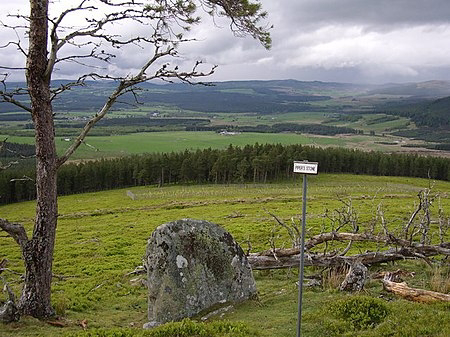
The  Piper's Stone , a boulder upon which a mortally wounded Jacobite piper was said to have played the bagpipes during the Battle of Cromdale The Haughs Of Cromdale. This ballad, the original author unknown, was collected and edited by James Hogg and concerns the Battle of  Cromdale  in Scotland, fought on April 30 and May 1, 1690 between supporters of James VII, called Jacobites, and the supporters of William III. The Jacobites would be defeated in two engagements near Cromdale village, Strathspey. The ballad describes details of the battle and the participants, but although a defeat by the Jacobites the unknown author turns it into a victory by adding details of the  Battle of Auldearn , which was fought by Royalists led by the Marquis of Montrose years before on May 9, 1645, and wrongly mixes up the opponents who were Scottish Covenanters with Oliver Cromwell's Roundheads. It is possible that elements of the little known  Battle of Tul...

Hielan Sodger (Trad.) - Highland Soldier

Image
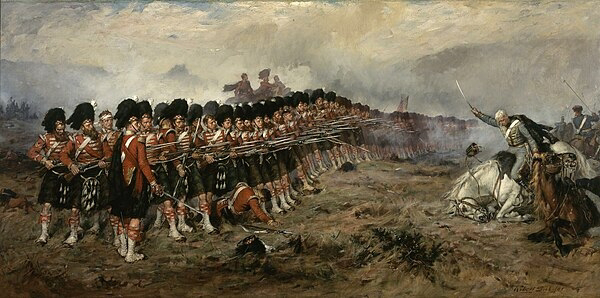
The Thin Red Line  was an military action of the  Battle of Balaclava  on 25 October 1854, during the  Crimean War  where Highlander infantry stood their ground against charging Russian horse-troops, and caused them to retreat. Robert Gibb, The Thin Red Line , 1881,  National War Museum , Edinburgh Henri FĂ©lix Emmanuel Philippoteaux General Michel Ney’s French cavalry  attacks the Highland regiments at Waterloo, June 18, 1815, only to be driven back by well-timed volleys. Scots in Highland uniform enduring the rain before the artillery shells fall at The Battle of the Somme, July 1 - November 1916 The 51st Highland Division at the Battle of El Alamein, October 1942 Hielan Sodger (trad.) The author of the song is unknown. The song concerns the love of a girl for a Highlander called up to a military regiment to travel overseas. She determines to sacrifice everything and follow him. The author of the song is unkn...

The Battle of Otterburn

Image
The Death of Douglas at the Battle of Otterburn on 5th August 1388: picture by Sir John Maxwell The Battle of Otterburn took place on August 5, 1388. It was part of a three-pronged assault by Scottish forces against the English. A Scots army sailed across the Irish Sea to attack Carrickfergus, the Duke of Albany raided the western marches towards Carlisle, and James Douglas, 2nd Earl of Douglas, attacked Henry Percy in Northumberland. Douglas defeated Percy, but was killed in the battle. The ballad -  The Battle of Otterburn  appears in a manuscript dated circa 1550. The author is unknown.  It was printed on broadsides as both  The Battle of Otterburn  and  The Battle of Otterbourne .  It was later printed in Percy's  Reliques , collections by David Herd (1776) and Walter Scott's  Minstrelsy of the Scottish Border  (1833). The  Child  B allads  are  305  traditional  ballads  from England an...